- Home Page /
- Books /
- Science & Math /
- Mathematics /
- Applied /
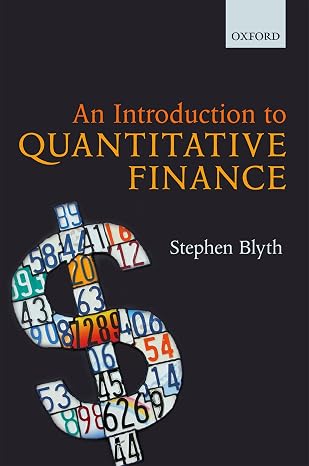
- An Introduction to Quantitative Finance

Item #:
11696967
An Introduction to Quantitative Finance
Item #:
11696967
USD 72
Price Details
Excluding Shipping & Custom charges ( Shipping and custom charges will be calculated on checkout )
*All items will import from US
0 ratings
Write a review
In stock
 Imported from USA store
QTY:
Order now and get it around Sunday, August 16
Secured transaction
Ubuy works hard to protect your security and privacy. Our advanced payment security system ensures confidentiality by encrypting your information during transmission using AES (Advanced Encryption Standards) and SSL (Secure Socket Layer) protocols. Your payment details are 100% secure as we do not share your payment details with third party sellers.
Our Top Logistics Partners


The quantitative nature of complex financial transactions makes them a fascinating subject area for mathematicians of all types, whether for general interest or because of the enormous monetary rewards on offer.

Fast
Shipping

Free
Return*

Secure Packaging

100% Original Products

PCI DSS Compliance

ISO 27001 Certified


Note: Step Down Voltage Transformer required for using electronics products of US store (110-120). Recommended power converters Buy Now.


What Stands Out
Comprehensive Coverage
This book provides a thorough introduction to quantitative finance concepts, making it ideal for beginners and seasoned professionals looking to refresh their knowledge in financial modeling and risk management.
Practical Examples
Filled with real-world applications and case studies, the text effectively bridges theory and practice, enabling readers to grasp complex quantitative techniques applicable to today's financial markets.
Clear Explanations
The author simplifies intricate mathematical concepts through clear language and visuals, ensuring accessibility for readers without extensive mathematical backgrounds, thus broadening its appeal to a wider audience.
Product Details
- Written by Stephen Blyth, Professor of the Practice of Statistics and Managing Director of Harvard Management Company
- Offers a refreshing approach to old results in the post-crisis world
- Provides insights into issues facing practitioners in applied quantitative finance and derivative markets
- Author has extensive experience in the finance industry, having worked at Deutsche Bank and Morgan Stanley
- Frequent speaker at international finance conferences
- Hold a PhD in Statistics from Harvard University and an MA in Mathematics from Christ's College, Cambridge University
| Publisher | Oxford University Press |
| Publication date | December 1, 2013 |
| Edition | First Edition |
| Language | English |
| Print length | 175 pages |
| ISBN-10 | 0199666598 |
| ISBN-13 | 978-0199666591 |
| Item Weight | 2.31 pounds (1.05 kg) |
| Dimensions | 9.1 x 6.1 x 0.6 inches (23.1 x 15.5 x 1.5 cm) |
Who Should Buy?

-
Finance Students
Ideal for undergraduate and graduate students seeking foundational knowledge in quantitative finance methodologies.
-
Professionals Transitioning
A great resource for finance professionals looking to transition into roles involving quantitative analysis and financial modeling.
-
Self-Learners
Beneficial for individuals interested in self-study to understand financial principles through mathematical and statistical approaches.

-
Complete Beginners
Not suitable for those without any prior knowledge of finance or mathematics, as it requires some background understanding.
Product Description
An Introduction to Quantitative Finance
About This Item
Enhance your understanding of quantitative finance with "An Introduction to Quantitative Finance 1st Edition." This comprehensive textbook written by Stephen Blyth, an esteemed professor and managing director at Harvard University, provides a thorough exploration of the field. Whether you're a finance student or a professional looking to expand your knowledge, this book serves as a valuable resource. Blyth's refreshing approach to old results offers a template for the future, making it a must-have for those interested in the post-crisis world of finance. As a Professor of the Practice of Statistics, Blyth brings a unique perspective to the subject matter. His extensive experience in applied quantitative finance and derivative markets is reflected in the content of the book, making it highly relevant to practitioners in the field. Covering a wide range of topics, this textbook delves into the basics of quantitative finance, including market analysis, trading strategies, and risk management.
It explores mathematical models and econometrics used in quantitative finance, as well as asset and option pricing. What sets this book apart is its emphasis on practical application. Blyth provides real-world examples and case studies, illustrating how quantitative finance concepts are applied in practice. This approach not only aids in understanding complex theories but also equips readers with the skills necessary to excel in quantitative finance careers. Whether you're interested in pursuing a degree in quantitative finance or seeking to enhance your existing knowledge, "An Introduction to Quantitative Finance 1st Edition" provides the essential foundation.
Order your copy today and embark on a journey into the exciting world of quantitative finance.
Have any Query? Chat with us
Customer Questions & Answers
-
Question:
What are the main topics covered in An Introduction to Quantitative Finance First Edition?
Answer: An Introduction to Quantitative Finance First Edition encompasses essential topics such as financial modeling, risk management, and the application of statistical tools in finance. The book provides a solid foundation in quantitative finance, exploring methodologies for pricing derivatives, portfolio optimization, and market risk assessment. By focusing on these core areas, the book serves as a comprehensive resource for students and professionals seeking to deepen their understanding of quantitative techniques in finance. -
Question:
Who is the target audience for An Introduction to Quantitative Finance First Edition?
Answer: This book primarily targets undergraduate students, graduate students, and professionals in finance, economics, and related fields. It's ideal for those looking to grasp the mathematical and statistical concepts behind financial instruments and markets. Furthermore, practitioners in investment banking, asset management, and risk assessment will find it an invaluable resource for enhancing their quantitative skill set and applying theoretical knowledge in practical scenarios. -
Question:
What is the writing style of An Introduction to Quantitative Finance First Edition?
Answer: The writing style of this edition is clear and accessible, making complex concepts understandable for readers with varying levels of experience. It combines theoretical insights with practical examples, providing clarity on quantitative methods used in finance. This approach helps demystify technical jargon, ensuring that readers can apply their newfound knowledge effectively in academic and professional settings. -
Question:
Are there any accompanying resources for An Introduction to Quantitative Finance First Edition?
Answer: Yes, An Introduction to Quantitative Finance First Edition often comes with supplementary materials, such as instructional software or access to online resources. These tools enhance learning through practical applications, simulations, or detailed datasets. Utilizing these resources can significantly enhance the understanding of quantitative methods and theories discussed in the book, catering to a hands-on learning experience. -
Question:
What prerequisites should I have before reading An Introduction to Quantitative Finance First Edition?
Answer: A solid grasp of basic statistics, calculus, and finance principles is helpful before diving into An Introduction to Quantitative Finance First Edition. Familiarity with financial concepts like assets, markets, and risk will allow readers to engage more deeply with the material. This foundational knowledge enhances the learning experience by enabling readers to contextualize quantitative methods within the larger scope of finance. -
Question:
How does An Introduction to Quantitative Finance First Edition compare to other finance books?
Answer: An Introduction to Quantitative Finance stands out for its unique focus on the integration of quantitative methods with finance concepts. While many finance books touch on quantitative topics, this edition provides an in-depth exploration of statistical and mathematical techniques essential for today's data-driven financial environments. Its balance of theory and practice makes it distinct among both introductory and advanced materials available in the market. -
Question:
Can An Introduction to Quantitative Finance First Edition aid in exam preparation?
Answer: Absolutely! An Introduction to Quantitative Finance First Edition serves as an excellent study aid for exams focused on quantitative analysis in finance. Its structured approach to key concepts and problem-solving techniques equips readers with the knowledge needed to succeed in various assessments. Additionally, the illustrative examples and practice problems help reinforce learning, making it an effective tool for exam preparation. -
Question:
What makes quantitative finance important in today's financial world?
Answer: Quantitative finance is crucial in today's financial landscape because it enables professionals to make data-driven decisions, manage risks, and optimize investment strategies. The application of quantitative methods allows for precise modeling of complex financial systems, enhancing the ability to forecast market movements and evaluate asset pricing. By understanding quantitative finance, professionals can leverage analytical tools to navigate an increasingly complex market environment effectively. -
Question:
Are mathematical skills necessary to understand An Introduction to Quantitative Finance First Edition?
Answer: While strong mathematical skills certainly enhance comprehension, An Introduction to Quantitative Finance First Edition is designed to introduce concepts progressively. Readers are guided through mathematical frameworks and their applications in finance, allowing even those with limited mathematical backgrounds to grasp the foundational aspects of quantitative finance. This incremental approach ensures that readers can effectively apply their learning, irrespective of their initial skill level. -
Question:
Where can I buy An Introduction to Quantitative Finance First Edition in Lebanon?
Answer: You can purchase An Introduction to Quantitative Finance First Edition on Ubuy. They offer a wide selection of books and ensure a smooth purchasing process for readers in Lebanon. Ubuy provides detailed product descriptions, customer reviews, and a user-friendly interface, making it an excellent choice for obtaining this educational resource.
Applied Editorial Review
The "An Introduction to Quantitative Finance 1st Edition" is a well-structured, clearly written book that is useful for financial students and is also reasonably priced. The book is very compact and offers a good feel for the theory of valuing derivatives. The exercises are well thought out with a good mix of computational ones, but also many that require more careful thought. However, some readers think that the book does not have much practical use and that most of its content is readily available online for free. Additionally, the Kindle version of the book may have formatting issues, so it might be better to opt for the paperback version.
Customer Reviews & Ratings
1 customers ratings
-
5 Star
100%
-
4 Star
0%
-
3 Star
0%
-
2 Star
0%
-
1 Star
0%
Review this product
Share your thoughts with other customers
Pros
- Affordable price
- Well-structured
- Clear writing
- Compact book
- Provides a good feel for the theory of valuing derivatives
- Well-thought-out exercises
Cons
- Not much practical use
Platform Trust & Buyer Confidence

MA
Mohammad
Verified buyer
“Excellent quality and original too,when ubuy send original things I will appreciate that ,I very satisfied thank you”
23 July 2026 · via Trustpilot
CK
Chitra
Verified buyer
“The order and delivery progress was communicated very well. Package arrived within the estimated time. Products arrived as expected in good condition.”
22-Jul-26 · via Trustpilot
K
kund
Verified buyer
“Good supply of products. Safe payment methods, and shipment worldwide! Genuine products.”
23-Jul-26 · via Trustpilot
OO
Onesi
Verified buyer
“Was my first time buying a product from Ubuy, but I found it so helpful. This is reliable. Gonna place a new order!”
22 July 2026 · via Trustpilot
SJ
SAO JOHN
Verified buyer
“Ubuy is a great online platform to buy stuff. Reliable, fast delivery time and great value for money. I've been using Ubuy online shopping platform for three years now and will continue to do so.”
23 July 2026 · via Trustpilot
Secure Checkout
Global Delivery
Easy Returns
Genuine Products
Product Price History
Important information
- Limitations : For products shipped internationally, please note that any manufacturer warranty may not be valid; manufacturer service options may not be available; product manuals, instructions, and safety warnings may not be in destination country languages; the products (and accompanying materials) may not be designed in accordance with destination country standards, specifications, and labeling requirements; and the products may not conform to destination country voltage and other electrical standards (requiring use of an adapter or converter if appropriate). The recipient is responsible for assuring that the product can be lawfully imported to the destination country. When ordering from Ubuy or its affiliates, the recipient is the importer of record and must comply with all laws and regulations of the destination country.
- Not all the products listed on Ubuy are for sale, as Ubuy is a global search engine. Products are subject to export/trade regulations.
USD 72
Order now and get it around Sunday, August 16
This item is not restrict in my country.(Please click on above link if this item is not restrict in your country, So our team will review and allow.)
QTY:
Secured transaction
PCI DSS compliant and ISO 27001:2022 certified, with encrypted payments and full buyer protection on every order.
Our Top Logistics Partners
Fastest cross-border delivery
Features & Benefits
- An Introduction to Quantitative Finance is a book on financial derivatives and the probabilistic tools developed to analyze them.
- The text is motivated by the author's experience trading derivatives on Wall Street, offering an unusual blend of real-world trading experience and rigorous academic background.
- Probability provides key tools for analyzing and valuing derivatives - the price of a derivative is closely linked to the expected value of its payout.
- The book is self-contained and suitable for a one-semester course, requiring only an introductory undergraduate course in probability.
- The text provides signposts for more advanced topics and different approaches for those looking to take the subject further.
- The book may appeal to students who have enjoyed probability and have a desire to see how it can be applied.
Ubuy Assurance
Experience worry-free shopping with 100% original products, PCI DSS-compliant payment security, ISO 27001-certified data protection, the fastest cross-border delivery, free returns *, and secure packaging on every order.